Simple circuits using batteries
Date : 13 April 2013
Have you ever heard your jumper crackle when you take it off? This is caused by teeny-tiny electric charges on your clothes, and called static electricity.
As your jumper and shirt rub together, they get electrically charged, and then negative electric charges jump from one to the other. This makes small, small sparks that you can hear as a crackle.
Electric current
When electric charges flow in a wire, we call that an electric current.
But to make electricity flow, we need to make apotential difference (voltage), electricity will flow through from positive (+) to the negative along a conductor (wire) through a component e.g. a light bulb.
|
Electric circuitsAn electric current will not flow if we do not have a power source with a potential difference across the terminals (a cell, battery or power pack). This is referred to as voltage (V). It also won't flow if the circuit is not complete. A wire conductor and components of the circuit must join one end of the power source to the other end.
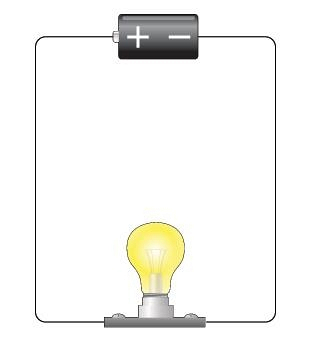
The simplest circuit is a piece of wire from one end of a battery to the other. An electric current can flow in the wire from one end of the battery to the other, but nothing useful happens: the wire gets hot and the battery goes flat. To do something useful with the electric current, we need to put an electrical componentinto the circuit, such as a lamp or a buzzer that can use the current to make something happen.
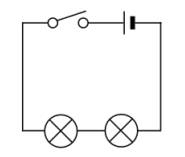
We can add in a switch to the circuit, so we can break the circuit and stop the electric current when we want to. There are two basic types of connections in a circuit: series and parallel connections.Series This is characterised by components that are connected in a row, just like a TV series. If you follow the circuit diagram from one side of the battery to the other, you should pass through all the different components one after another.
In a series circuit, if a lamp breaks or a component is disconnected, the circuit is broken so all the components stop working. Series circuits are useful if you want a warning that one of the components in the circuit has failed.
If you connect batteries in a series, one after another, you increase the voltage within the circuit. So two 1.5v batteries connected in series will give you a potential difference of 3v if measured from the top of the first battery’s positive and the second battery’s negative.
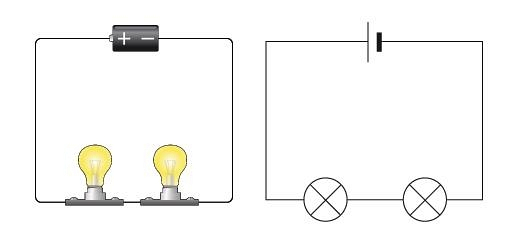
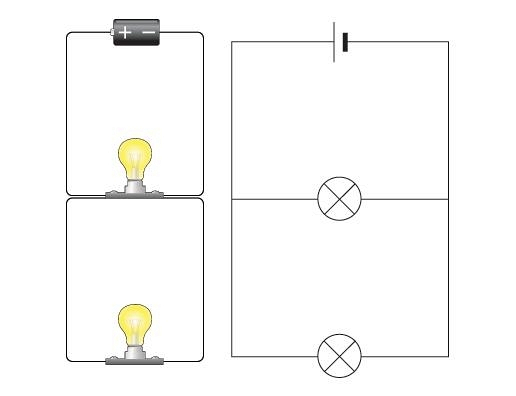
Parallel In parallel circuits different components are connected on different branches of the wire. The diagram shows a circuit with two lamps connected in parallel. If one lamp breaks, the other lamp will still light up. And, unlike a series circuit, the lamps stay bright if you add more lamps in parallel. Parallel circuits are useful if you want everything to work, even if one component has failed.
In a parallel circuit, if batteries are connected in, you can draw electricity for longer but the potential difference will remain the same, so two 1.5v batteries will still have a potential difference of 1.5v.
For a circuit to work, there are two important things:
To check for a complete circuit, follow a wire coming out of the battery with your finger. You should be able to go out of the battery from one terminal, through the lamp and back to the other terminal of battery.
To check for a short circuit, see if you can find a way past the lamp without going through any other component. If you can, then there is a short circuit and the lamp will not light. |
    |
Try this at home!
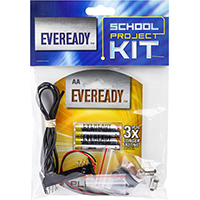
Eveready school kits are available to buy and start making your own circuits at home to experiment with. Each pack includes four Eveready Platinum Alkaline 9v batteries (or) 2AA Eveready Platinum Alkaline 1.5V batteries, rip chord wire 0.5mm core, a cavity holder/connector, two screw base lamps, two screw base connectors and one in-line switch.